Editorial Policy
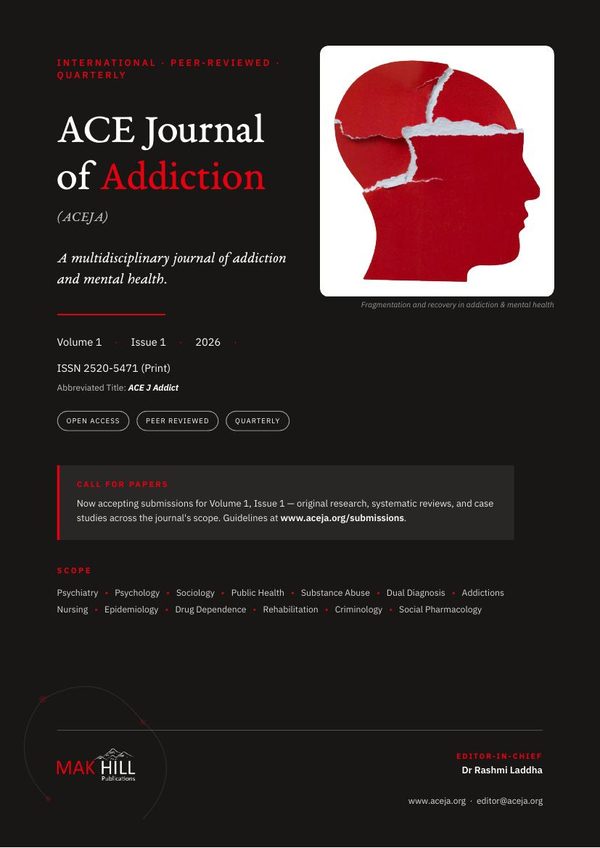
ACE Journal of Addiction (ACEJA) is committed to maintaining the highest standards of editorial quality, academic integrity, transparency, and ethical publishing practice. The journal follows a rigorous editorial process to ensure that all published content contributes meaningful, original, and reliable knowledge to the fields of addiction, mental health, psychiatry, and related psychosocial and public health disciplines.
Editorial Independence
The Editorial Board maintains full independence in evaluating, reviewing, and making publication decisions. Editorial decisions are based solely on the academic and clinical merit, originality, relevance, methodological quality, and contribution of the manuscript to the journal's scope.
The journal does not allow commercial interests, sponsors, advertisers, pharmaceutical or treatment-industry affiliations, or external organizations to influence editorial decisions.
Manuscript Evaluation Process
All submitted manuscripts undergo an initial editorial screening to determine:
- Relevance to the journal's aims and scope
- Originality of research
- Compliance with submission guidelines
- Ethical compliance, including evidence of informed consent and ethics committee/IRB approval for studies involving human participants
- Language quality and formatting requirements
Manuscripts that do not meet the journal's requirements may be returned to authors for correction or rejected without external review.
Peer Review Policy
ACEJA follows a double-blind peer review process, where:
- Authors remain anonymous to reviewers
- Reviewers remain anonymous to authors
Each manuscript is typically reviewed by at least two subject experts.
Reviewers evaluate manuscripts based on:
- Originality and novelty of the research
- Scientific or clinical validity and rigor of the methodology
- Ethical conduct, including protection of human participants and confidentiality of patient data
- Contribution to the understanding, prevention, or treatment of addiction and mental health conditions
- Clarity, structure, and quality of scholarly writing
Based on reviewer recommendations, the editorial team may issue one of the following decisions:
- Accept
- Minor Revision
- Major Revision
- Reject
The Editor-in-Chief reserves the right to make final publication decisions.
Editorial Decision Timeline
The journal aims to provide timely editorial decisions:
- Initial screening: 3–7 working days
- Peer review process: 2–6 weeks
- Final decision after revisions: 1–2 weeks
Timelines may vary depending on reviewer availability and manuscript complexity.
Ethical Publishing Standards
ACEJA follows publication ethics principles consistent with Committee on Publication Ethics (COPE) guidelines. Given the clinical and psychosocial nature of much of the journal's content, authors reporting research involving human participants — including studies on substance use, dual diagnosis, or vulnerable populations such as adolescents or individuals in recovery — must confirm that the study was approved by an appropriate institutional ethics committee and that informed consent (and assent, where applicable) was obtained.
Conflict of Interest
Editors, reviewers, and authors must disclose any conflicts of interest that may influence the publication process, including financial relationships with pharmaceutical companies, treatment centers, or advocacy organizations relevant to the manuscript's subject matter.
Editors may recuse themselves from handling manuscripts where conflicts exist.
Data Integrity and Plagiarism
All submissions are screened for plagiarism prior to peer review. Authors are expected to present accurate, unaltered data; fabrication, falsification, or image manipulation will result in rejection or retraction. Authors are encouraged to make anonymized data available upon reasonable request, consistent with participant confidentiality.
Corrections and Retractions
If significant errors, ethical concerns, or misconduct are identified after publication, the journal may publish:
- Corrections
- Expressions of concern
- Retractions
where necessary.
Confidentiality
All manuscripts submitted to ACEJA are treated as confidential documents. Editors and reviewers must not disclose manuscript content — including any identifiable patient or participant information contained within it — to unauthorized individuals.
Special Issues
The journal may publish special issues on emerging themes related to addiction science, mental health policy, behavioral addictions, public health interventions, and other subjects depending on need or the editorial board's discretion.
All special issue submissions follow the same editorial and peer review process as regular submissions unless otherwise specified.
Appeals and Complaints
Authors may appeal editorial decisions by submitting a formal written request with supporting justification. The editorial board will review appeals independently of the original decision-makers where possible.
Final Editorial Responsibility
The editorial board is responsible for ensuring:
- Fair review processes
- Academic and clinical quality
- Ethical compliance
- Transparency
- Timely publication
ACEJA remains committed to publishing impactful, interdisciplinary research that advances the understanding, prevention, and treatment of addiction and mental health conditions worldwide.